
The Florida Project
What to make of the Trump-Zelensky meeting in Mar-a-Lago.

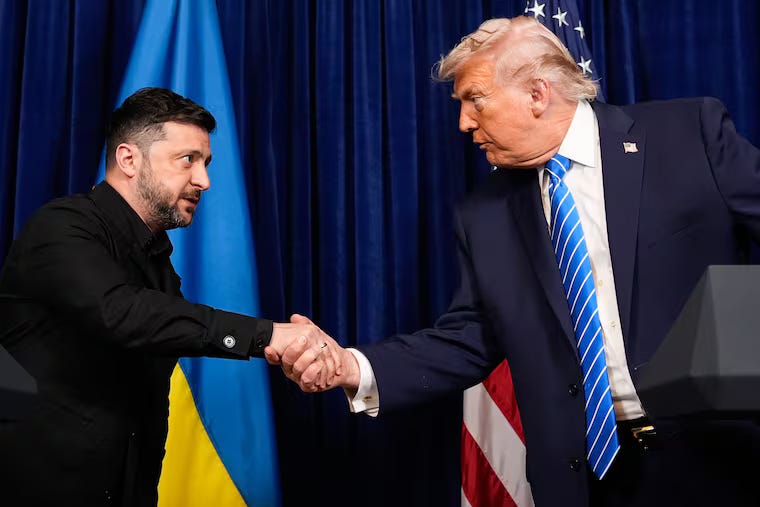
Alex Brandon /AP
The Trump-Zelensky meeting and press conference at Mar-a-Lago happened yesterday and the best that can be said of it is that it was anticlimactic, moderately insulting to one’s intelligence, and over quickly. No fireworks, no showdowns, no spectacle. There were even a few pleasantries exchanged. The Ukrainian president stood at a podium, not for the first or last time, wondering how the fate of 44 million could rest in the tiny hands of a hebephrenic pit boss who somehow became leader of the free world.
Donald Trump remains hopelessly devoted to Vladimir Putin’s non-existent good will and much of the follow-on reporting will be about the outlandish stupidity of his commentary, which centered on his thwarted bromance with the Russian dictator. Trump unexpectedly rang up Putin and had a “productive” call which lasted over an hour – before Zelensky arrived. He and Putin have a kinship, the American president reminded the gathered journalists in Florida, because both were victims of Hillary Clinton and Adam Schiff’s “Russia hoax.” The war in Ukraine started because of Joe Biden (even though it started in 2014, when Barack Obama was president) and would never have happened were the 2020 election not “rigged” to deny Trump an uninterrupted occupancy of the White House. Russia wants to end the war as much as Ukraine does, even though the U.S. intelligence community assesses that Putin’s territorial ambitions to conquer all of Ukraine and other additional territories formerly occupied by the Soviet Union remain unchanged.
To this familiar dungheap of untruths, Trump added a fresh dropping: Putin wants “Ukraine to succeed,” he declared, not 24 hours after Russia launched 40 missiles and 519 drones at Kyiv, the largest single-day attack in months, targeting apartment blocks, a university dormitory and other civilian structures, killing two and rendering large swaths of the capital without electricity. Even Zelensky couldn’t suppress a mirthless laugh.
Trump’s fixation on America’s deferred strategic realignment with Russia is nothing new, nor is his drawing of moral equivalence between the invader and the invaded. Just after Zelensky pulled up to the gates of Mar-a-Lago, Trump was likening Russia’s war crimes against women and children to Ukraine’s lawful deep strike campaign against Russia’s energy infrastructure. (One of those attacks, on Christmas Day, hit the Novoshakhtinsk oil refinery in Rostov with British-supplied Storm Shadow cruise missiles, meaning it must have been authorized by Gen. Alexus Grynkewich, the NATO Supreme Allied Commander, because he has final say on the use of any Western munitions fired into Russia.)
So what was achieved and what was this meeting even about?
Over the past month, a Russian-authored 28-point plan for ending the war on terms highly unfavorable to Ukraine, which was laundered in the American media as a joint U.S.-Russian “framework,” was heavily de-Russified between and amongst three parties: the United States, Ukraine and Europe. So far as we know, the new version has been revised without any Russian input or influence, and the chatter from Moscow has been uniformly hostile to any changes from the preferred original.
Of significance here is that the leads on the American side were Jared Kushner, Trump’s son-in-law, and Steve Witkoff, Trump’s business crony turned all-purpose envoy, who moonlights as a WhatsApp adviser to the Russian presidential administration and was handpicked to be Trump’s negotiator by Putin himself. In other words, what was cobbled together in anticipation of the Mar-a-Lago sitdown was a joint U.S.-Ukrainian product, written in consultation with one of the most Kremlin-aligned American diplomats. Trump could therefore not publicly disavow this plan or characterize it as unreasonable without attacking his own delegation. That was Zelensky’s first tactical victory in this round.
The 28 points have been whittled down to 20 and read as follows, according to the Kyiv Independent. (I have also left that outlet’s helpful annotations, featuring Zelensky’s elaboration of certain provisions):
1. The signatories affirm that Ukraine is a sovereign state.
2. The document constitutes a full and unquestionable non-aggression agreement between Russia and Ukraine. A monitoring mechanism will be set up to oversee the conflict line using satellite-based unmanned surveillance, ensuring early detection of violations.
3. Ukraine will receive security guarantees.
4. The size of Ukraine’s Armed Forces will remain at 800,000 personnel during peacetime.
5. The U.S., NATO, and European signatory states will provide Ukraine with “Article 5–like” guarantees. Following points apply:
A) If Russia invades Ukraine, a coordinated military response will be launched, and all global sanctions against Russia will be reinstated.
B) If Ukraine invades Russia or opens fire at Russian territory without provocation, the security guarantees will be considered void. If Russia opens fire on Ukraine, the security guarantees will come into effect.
C) The U.S. will receive compensation for providing security guarantees. (This provision has been removed.)
D) Previously signed bilateral security agreements between Ukraine and around 30 countries will remain in place.
6. Russia will formalize its non-aggression stance towards Europe and Ukraine in all necessary laws and documents, ratifying them by Russia’s State Duma.
7. Ukraine will become an EU member at a clearly designated time and will receive a short-term preferential access to the European market.
“As of today, the timing of Ukraine’s accession is a bilateral discussion between the United States and Ukraine, without European confirmation for now,” Zelensky said.
“Membership in the European Union is also our security guarantee, and therefore we want to set a date — when this will happen. For example, 2027 or 2028.”
8. Ukraine will receive a global development package, detailed in a separate agreement, covering various economic areas:
A) A development fund will be created for investing in fast-growing industries, including technology, data centers, and artificial intelligence.
B) The U.S. and U.S. companies will work with Ukraine to jointly invest in the restoration, modernization, and operation of Ukraine’s gas infrastructure, including pipelines and storage facilities.
C) Joint efforts will be made to rebuild war-torn areas, focusing on restoring and modernizing cities and residential neighborhoods.
D) Infrastructure development will be prioritized.
E) Extraction of minerals and natural resources will be expanded.
F) The World Bank will provide a special funding package to support the acceleration of these efforts.
G) A high-level working group will be established, including the appointment of a leading global financial expert as the prosperity administrator to oversee the implementation of the strategic recovery plan and future prosperity.
9. The creation of several funds to address the restoration of the Ukrainian economy, the reconstruction of damaged areas and regions, and humanitarian issues will be established. The aim is to mobilize $800 billion, the estimated cost of the damage from the Russian war.
10. Ukraine will accelerate the process of negotiating a free trade agreement with the U.S.
11. Ukraine reaffirms its commitment to remaining a non-nuclear state, in accordance with the Treaty on the Non-Proliferation of Nuclear Weapons.
12. Control over the Zaporizhzhia Nuclear Power Plant and the restoration of the Kakhovka Hydroelectric Power Plant.
Washington proposes that the Zaporizhzhia nuclear plant be jointly operated by Ukraine, Russia, and the U.S., with each country controlling 33%, and the U.S. serving as the primary overseer of the station.
Ukraine opposes Russian control over the plant. Kyiv proposes that the plant be managed by a joint venture consisting of the U.S. and Ukraine, where 50% of the electricity generated will go to Ukrainian-controlled territories, while the U.S. determines the distribution of the other 50%.
“We believe that for all of this to take place and function safely, the Zaporizhzhia Nuclear Power Plant, the city of Enerhodar, and the Kakhovka Hydroelectric Power Plant must be demilitarized, because at present there are Russian troops and war there, and there is no necessary level of security,” Zelensky said.
13. Ukraine and Russia will introduce school courses that promote understanding and tolerance of different cultures, fight racism and prejudice. Ukraine will approve EU rules on religious tolerance and minority language protection.
14. In Donetsk, Luhansk, Zaporizhzhia, and Kherson oblasts, the line of military positions on the date of signing will be recognized as the de facto front line.
A) To determine troop movements needed to end the war and set up potential “free economic zones,” with Russia withdrawing its troops from these areas.
B) Russia must withdraw its troops from occupied parts of Dnipropetrovsk, Mykolaiv, Sumy, and Kharkiv oblasts for the agreement to take effect.
C) International forces will be placed along the front line to monitor the agreement’s implementation.
D) The parties agree to follow the rules and obligations imposed by the 1949 Geneva Conventions and their additional protocols, including universal human rights.
“So we are in a situation where the Russians want us to withdraw from Donetsk Oblast, while the Americans are trying to find a way for us not to withdraw because we are against withdrawal,” Zelensky said.
“They are looking for a demilitarized zone or a free economic zone, meaning a format that could satisfy both sides. We consider a free economic zone a potential option for a sovereign state to choose such a path. We fought for a single word — ‘potential.’ We believe that such potential economic zones can exist,” he added.
“We are saying: if all regions are included and if we remain where we are, then we will reach an agreement. That is why it says ‘potential zones’ here. But if we do not agree to ‘remain where we are,’ there are two options: either the war continues, or something will have to be decided regarding all potential economic zones.”
15. Russia and Ukraine commit to refraining from using force to alter territorial arrangements and will resolve any disputes through diplomatic means.
16. Russia will not obstruct Ukraine’s use of the Dnipro River and the Black Sea for commercial purposes. A separate maritime agreement will ensure freedom of navigation and transport, with the Russian-occupied Kinburn Spit being demilitarized.
17. Establishment of a humanitarian committee that will ensure the following:
A) All-for-all prisoner exchange.
B) All detained civilians, including children and political prisoners, will be freed.
C) Actions will be taken to address the problems and alleviate the suffering of conflict victims.
18. Ukraine must hold presidential elections as soon as possible after the deal is signed.
19. The deal will be legally binding. Its implementation will be monitored by the Peace Council, chaired by U.S. President Donald Trump. Ukraine, Europe, NATO, Russia, and the U.S. will be part of this process. Violations will lead to sanctions.
20. The ceasefire will take effect immediately once all parties agree to the deal.
Zelensky seemed sanguine as to the results of yesterday’s conversation.He claimed that the framework is “90 percent” of the way to completion between the U.S. and Ukraine, and that U.S. security guarantees are “100 percent” done. Trump put the latter estimate at a hair-splitting “95 percent,” but when asked if he were ready to sign a document locking in those guarantees, Trump demurred, telling the Kyiv Post’s Alex Raufoglu, “Nobody even knows what the security agreement is going to say. But there will be a security agreement. It’ll be a strong agreement.”
Both Zelensky and Trump agreed that a major obstacle remains the question of the final status of Donbas, where Ukraine currently retains about 30 percent of the Donetsk region, home to some 250,000 people. A “free economic zone,” as per the above, would require Ukraine to withdraw its forces from that area, and for Russia to likewise pull back its own troops. Russia has shown no interest or willingness to do so and demands Ukraine hand over the remaining third of Donetsk, something Zelensky and his government will not do. Demilitarizing the Ukrainian-controlled part of the oblast is itself a massive concession by Kyiv, but not one as painful as forfeiting the territory to Russia.
Lately, Zelensky has floated making the entirety of the 20-point proposal not dependent on a presidential signature but on the will of the Ukrainian people via a referendum. Trump professed to like that idea. Here Zelensky is trying to do two things at once and score another tactical victory for himself.
The first is to forswear sole responsibility (or blame) for the fate of Ukraine and have any peace deal ratified to ensure his legacy as a successful wartime president not be tarnished by bartering away what was never lost to Russia. It is no small thing to voluntarily reduce Ukraine’s footprint in the Donetsk, a “fortress belt,” in the words of Andriy Zagorodynuk, Ukraine’s former defense minister, which runs about 30 miles down from Slavyansk and Kramatorsk in the north to Druzhkivka and Kostiantynivka in the south. The first two cities are major logistics nodes for the Ukrainian Armed Forces, not to mention the sites of some of the most hardwon battles that followed Russia’s first invasion a decade ago – the veterans of which are now in commanding positions in Ukraine’s military hierarchy, if not elected officials. If the Russians were to take these areas, it’d put them within striking distance of other places in central Ukraine, such as Dnipropetrovsk. However, the Institute for the Study of War, a nonpartisan think tank, calculates that it would take Russia “years” to conquer all of Donetsk militarily, at the cost of untold Russian lives. This is why Putin wants it given to him, and as a mere appetizer to the main course, which remains all of Ukraine.
Zelensky understands the geography, politics and military dynamics of his country. He seeks to put the Donetsk dilemma to a national vote to demonstrate that settling this and other thorny questions is a lot more difficult than real estate moguls from New York realize. For one thing, how do you hold an election under nightly bombardment of Ukrainian population centers without a ceasefire backed by the credible threat of escalation should Russia violate it? For another, who gets to vote in an All-Ukrainian referendum?
Zelensky was asked at the press conference about Ukraine’s refugee population in Europe, which numbers in the millions. Would they cast ballots? He replied that of course they would but that the “infrastructure” needed to allow them would be enormous. Well, who is going to put that infrastructure in place?
Furthermore, if Kyiv does not include in any plebiscite residents of occupied Crimea or occupied Donbas, Kherson and Zaporizhzhia, then the very purpose of holding a referendum on the future of Ukraine’s sovereignty will be undermined because voter eligibility itself would become a de facto recognition of what is and what is no longer Ukraine.
A word to look out for in the coming weeks is “sequencing”: the order by which the U.S. and/or Europe agrees to do something to ensure that Ukraine can do what is asked of it. Security guarantees, such as Western boots on the ground, will have to precede not follow any Ukrainian decision-making on a final settlement to the war. Trump may not realize this yet, but he will soon enough.
The numbers are not in favor of a quick and easy resolution, as Zelensky well knows.
The Kyiv International Institute of Sociology conducted a poll on December 15 and found that 75 percent of Ukrainians consider a withdrawal from Donbas, a cap on the size of the military, and a lack of concrete security guarantees “completely unacceptable.” Changing the minds of three quarters of the nation will mean incentivizing them to be changed, i.e. offering more than inane assurances that Russia has no further designs on Ukraine and wants to see it thrive.
Trump suggested he might deliver a speech before the Verkhovna Rada, Ukraine’s parliament, no doubt thinking he’d be as welcome and applauded there as he was before the Israeli Knesset. Let him think that.
Ukrainian politics is a briar patch in peacetime, and only someone who has spent no time in Ukraine could mistake war fatigue for an eagerness to capitulate.
Zelensky’s greatest asset may be that, unlike Putin, he has to answer to his people and his people are not shy about telling him when they don’t like what he says or does.
Trump’s biggest liability, apart from his galactic narcissism, may be thinking that he has only to bully and browbeat one person to get what he wants.
And we are still no closer to getting the Russians to agree on anything.
Exceptional analysis of the sequencing issue here. The detail on Point 16 about Black Sea freedom of navigation is crucial but kinda underplayed in most coverage I've seen, when it's actualy one of the more operationally critical elements for Ukranian sovereignty going forward. The referendum gambit is clever but risky because it buys time while exposing just how unrealistic this 'easy deal' framing really is. The voting eligibility question alone could take months to resolve.
An excellent and detailed account that clarifies the current negotiating positions. Russia, of course, will never agree and so must see its industrial/military base steadily eroded, despite superior numbers on the battlefield. Like all bullies, Putin believes in superior force until the end, distorting his views until his interpretation of the state of his military and civil infrastructure is no longer tenable. Despite mental and physical exhaustion, Ukraine will fight on to avoid the loss of its sovereignty and will never surrender to certain death or slavery. Putin must be defeated, and his ability to wage war must be destroyed, in order for Ukraine and democracy to survive.